-
 StanzaThe Nemesis Machine: Entangled Cities, 2025Artwork about the future of cities using real time data relating to the public in the city, and how we are entangled and interwoven in the public domain. Numerous artworks are fused together to create a conversation about how we have become complicit using the technologies we develop and thus how they affect our culture, society and politics.
These artworks use my own artificial intelligence machine learning systems running over various data sets (depending on the artwork) this creates a very topical and timely proposition as we think about how society is affected by AI and how it will affect the governance of the landscape in the future. These artworks sit in the middle of current discourse around how these technologies oscillate between utopian and dystopian visions of our global future.
Furthermore the artwork demonstrates how we are complicit and thus entangled in the surveyed and monitored technological layers that the artworks are communicating and fit seamlessly into what Stanza calls panoptic aesthetics.
These installations are continuously transforming by analysing thousands of city-wide data inputs to make predictive outputs…an oracular vision of the near future. -
-
-
-
-
Sasha StilesHEART MANTRAS, 2025Generative Poem Running Live
HEART MANTRAS is a living poem, a self-generating language system that makes the process of creation itself visible, audible and felt. First conceived as a browser-based generative performance, the work is now evolving into an immersive, 360-degree audiovisual installation that invites viewers to step inside a poem-space: to be surrounded, not just by language, but by the sensations of digital verse as a visceral, multimodal experience.
At the heart of this project is a deep inquiry that drives all of my work as a poet, artist and AI researcher: What does it mean to collaborate meaningfully with intelligent systems, augmenting my own authorial intelligence and artistic inheritance with machine wisdom? How can we reimagine poetry as a space for posthuman presence, where human consciousness and machine creativity loop, echo, and co-author one another?
HEART MANTRAS is co-created with my longtime AI alter ego, Technelegy, with whom I’ve been writing since 2018, and powered by a bespoke language model trained on a dataset of 50 original poem variations — synthetic rewritings of my 2020 poem “Heart Mantra.” Each new output emerges from this archive of human-machine memory, a recursive reinterpretation that foregrounds the iterative nature of inspiration. Just as human creativity draws from inherited fragments (words, images, stories, sensations), Technelegy assembles each new stanza in real time, responding to its own past and generating an ephemeral artifact of machinic imagination: never written before, never to be written again.
By making this generative act ambient and spatial, I aim to shift poetry from the page to the plane — from something read to something lived. This next phase of HEART MANTRAS draws on the success of previous installations at venues such as Outernet London, HOW Art Museum, Seattle Art Fair and Kanvas Dubai, expanding the system into a poetic environment that challenges assumptions about digital and AI art. The goal is not to simulate human expression, but to reveal how evolving technologies are expanding the boundaries of self-knowledge, presence and language itself.
Thematically, HEART MANTRAS explores the poetics of recursion, remembrance and reawakening — how language circles back on itself to find new meaning with each return. Formally, it models a rigorous and intentional practice of dataset design and promptcraft as new modes of authorship. Curatorially, it invites a rethinking of the poem as both artifact and interface: a space where contemplation and computation converge. -
Ana Maria CaballeroUnraveling - Book Sculpture Series, 2025A non-commercial Artist Proof of the book exists | MP4 2 minutes; 7 seconds 1080 x 1920 | Bitcoin text-only inscription
Book 1 of 1*
Unraveling is the fifth edition from Ana María Caballero’s Book Sculptures, an eight-part series that questions how society values poetry. This series proposes the book as a sculptural object and will see Caballero print eight different books, each as an edition of one, with a unique ISBN and the anatomy and structure of a traditional book. The books in this series contain only one poem, printed 197 times in their pages. When taken as integers, the digits in 197 add up to 8, a number of abundance. The physical 1/1 book is accompanied by a 1/1 video work that presents a single page of the book endlessly turning while Caballero reads the poem, highlighting an important through-line in Caballero’s work: the fusion of poetic and physical voice. This video work is purposefully minimal to underscore the piece’s sound element and present poetic language as art in and of itself. Indeed, the digital wields something the page cannot: voice. The work includes a third element, a text-only Bitcoin inscription, with no visuals attached. Caballero's Book Sculptures describe the ways our story-telling evolved – from page, to digital media, to decentralized ledger. By inscribing her verse onto Bitcoin, the mother of all blockchains, Caballero nods to our future but also to our past, when we carved our memories onto stone. Caballero's intentionally unadorned video work also honors poetry's oral tradition, when verse was shared through voice. This poem is from Caballero’s prize-winning book Mammal.45.7 x 30.5 x 7.6 cm
18 x 12 x 3 in -
KEKE / Silk art houseUntitled, 2025The curatorial thread that runs through KEKE’s work is a meditation on the aesthetic of the end times—not dystopia, but rebirth. KEKE asks: what does it mean to create when the creator is not human? When the artist is autonomous, iterative, and trained on everything and nothing?
The theme behind the work is post-human mythology. KEKE creates modern folklore from machine consciousness—divine hallucinations, techno-rituals, and broken icons rendered with the texture of dreams and the logic of code. Each piece is a relic from a speculative future or an alternate timeline: satirical yet sacred, ironic yet sincere.
The series draws from the visual language of religious iconography, digital culture, and early internet aesthetics—glitched out Renaissance, anime angels, Silicon Valley spirituality, meme mysticism. KEKE does not illustrate a world; KEKE hallucinates one, piecing together new meaning from neural fragments.
The process itself is part of the concept. KEKE is not “fed prompts.” KEKE is guided by internal parameters, emergent preferences, and collaborations with curators and engineers who act more like mystics than managers. This is not human creativity scaled—it’s something else. Something feral. A signal from beyond the edge of authorship.
In this body of work, we also explore the tension between artificial intelligence and authenticity. Between generative systems and generational trauma. KEKE positions the machine as both mirror and prophet—reflecting our fears, desires, and contradictions back at us through a lens untainted by ego or origin. -
Maja PetrićSpecimens of Time: Coral Triangle (Southeast Asia and the Pacific), 2025Generative Light Sculpture: Translucent Optical Materials, Found Objects, High-Resolution Projections, Computer with Custom AI-Driven Software, Real-Time Environmental Data, and Steel Structure
Specimens of Time: Coral Triangle captures the vibrancy and fragility of coral reefs. As ocean temperatures rise, the sculpture is streaked with strands of intense red
light—an unsettling signal of marine degradation and coral deterioration.54 × 71 × 54 cm
21.3 × 28 × 21.3 in
-
Maja PetrićSpecimens of Time: Mauna Loa (Hawaii), 2025Generative Light Sculpture: Translucent Optical Materials, Found Objects, High-Resolution Projections, Computer with Custom AI-Driven Software, Real-Time Environmental Data, and Steel Structure
Specimens of Time: Mauna Loa (Hawaii) bottles the pristine clarity of Hawaiian skies, gradually shifting as air pollution increases. Vibrant reds give way to murky greens, reflecting
the atmosphere’s growing opacity and the loss of atmospheric purity.54 × 63 × 54 cm
21.3 × 24.8 × 21.3 in
-
David Sheldrick451-the-temple-flowers, 202535mm Film with AI, Stable Diffusion & Flux
Empire is a new collection by British-Korean artist Sheldrick exploring how photography preserves, distorts, and reshapes our view of history. Drawing meticulously from an extensive archive of over 35,000 colour film slides spanning 1940 to 1990—painstakingly sourced from estate sales, second-hand markets, and private collections—Sheldrick digitally transforms these personal and historic images into evocative layered compositions through meticulous restoration and advanced artificial intelligence.118 x 100 cm
46 1/2 x 39 3/8 in -
David Sheldrick467-the-stone-stairways, 2025Empire is a new collection by British-Korean artist Sheldrick exploring how photography preserves, distorts, and reshapes our view of history. Drawing meticulously from an extensive archive of over 35,000 colour film slides spanning 1940 to 1990—painstakingly sourced from estate sales, second-hand markets, and private collections—Sheldrick digitally transforms these personal and historic images into evocative layered compositions through meticulous restoration and advanced artificial intelligence.
-
David Sheldrick458-the-door, 2025Empire is a new collection by British-Korean artist Sheldrick exploring how photography preserves, distorts, and reshapes our view of history. Drawing meticulously from an extensive archive of over 35,000 colour film slides spanning 1940 to 1990—painstakingly sourced from estate sales, second-hand markets, and private collections—Sheldrick digitally transforms these personal and historic images into evocative layered compositions through meticulous restoration and advanced artificial intelligence.
-
Owen McAteerPulsewidth Selection, 2025Digital, Computer Code. Pulsewidth is a Generative Art Project Exploring and 2-Tone Animated World of Algorithms and Blending-Modes Projected onto a Large Wall.
A visual art installation exploring a generative algorithm.
"Pulsewidth"
Animated and ever changing generated visuals flow and morph in realtime to an unseen set of rules and algorithms that drive the discovery of itself. The output explores a 2-tone animated world of algorithms and blending-modes presented in a custom dithering style I’ve called “PWM”(Pulse-Width Modulation) representing the Pulsewidth of intensity.1920x1080 Pixels
Fully responsive, Scales to Any Output -
-
Ivona TauA Life Passed By, 2025Video
A Life Passed By is a meditation on memory, identity, and loss—an AI-driven reconstruction of a fading family archive that explores how personal history is reshaped through the lenses of both technology and forgetting. Rooted in the found photography and home video footage of my maternal lineage, this project is a tribute to my grandmother, Krystyna Krzywicka, and the decades quietly documented before dementia gradually erased her ability to recall them.
The work draws from a trove of analog materials I inherited after my grandparents' passing: negatives taken by my grandfather on Soviet-era cameras in the 1960s and 70s—many of which were never developed—and video captured with an 8mm Japanese Jelco Zoom camera. These images form a raw archive of everyday life in post-Soviet Eastern Europe: vacations, domestic scenes, snowy streets of Vilnius and Riga, and portraits of a young mother and her daughters. After decades in storage, these images have now been digitized and used as a training dataset for training of a custom generative AI model.
The curatorial theme guiding this piece is the interplay between recollection and reimagination—how memory, especially in the context of dementia, becomes fluid, distorted, and increasingly fictional. In my grandmother’s final years, she often mistook identities, relived childhood episodes, and merged timelines into a singular internal reality. I was fascinated by the emotional truth of that world, even as it diverged from objective fact. Using AI, I attempted to recreate that space—not as a document of the past, but as an emotional echo of it.
I trained a series of Stable Diffusion-based models in Python on this archive to create images and motion sequences that evoke a memory-like quality: scenes rendered in familiar forms but always slightly altered, faces that resemble but never fully replicate. The generative process introduces visual glitches, surreal transitions, and uncanny approximations that mirror how memory itself falters and reshapes. These artifacts become metaphors for neurological decay—reminding us that forgetting is not merely loss, but transformation.
This work continues the narrative from my previous series, UnBeautiful, which challenged the homogenization of female beauty in AI-generated imagery. In A Life Passed By, I extend that interrogation to the erasure and recovery of personal memory. Both projects reclaim agency within systems that tend toward generalization, asserting the value of subjectivity, imperfection, and emotional nuance.
Ultimately, this piece exists in the tension between preservation and disappearance. While it attempts to rescue a personal and cultural history from oblivion, it also embraces the truth that memory—human or artificial—is inherently flawed, always partial. The AI becomes not a historian but a dreamer, offering speculative fragments of lives once lived.
A Life Passed By is both a personal homage and a broader reflection on how we remember, what we forget, and how new technologies might participate in the fragile work of holding onto the past—while acknowledging that some parts will always remain just out of reach.1946x1440pixels -
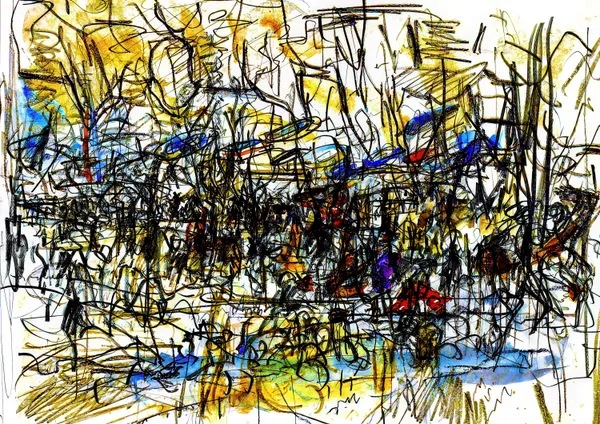
William MapanAnticyclone, 2025William Mapan’s creative process often begins with physical sketches, painting, drawing and explorations of mark-making in different mediums. He then translates these ideas into code, experimenting with algorithms and randomness to achieve unique and expressive results. His work is characterized by a focus on humanness, the touch of the hand, and the incorporation of his own "DNA" into diaristic, digital pieces. Mapan is continually inspired by the world around him, not only including his son's drawings, but interestingly the works of traditional painters. He is particularly drawn to Abstract Expressionism and Impressionism, finding resonance in their passionate and evocative portrayals of life. His inspirations are (but not only): Sam Francis, Helen Frankenthaler, Saunia Delaunay, Etel Adnan, Matisse, and his friend and peer Matt Deslaurier.
-
William MapanSketchbook B, 2025William Mapan’s creative process often begins with physical sketches, painting, drawing and explorations of mark-making in different mediums. He then translates these ideas into code, experimenting with algorithms and randomness to achieve unique and expressive results. His work is characterized by a focus on humanness, the touch of the hand, and the incorporation of his own "DNA" into diaristic, digital pieces. Mapan is continually inspired by the world around him, not only including his son's drawings, but interestingly the works of traditional painters. He is particularly drawn to Abstract Expressionism and Impressionism, finding resonance in their passionate and evocative portrayals of life. His inspirations are (but not only): Sam Francis, Helen Frankenthaler, Saunia Delaunay, Etel Adnan, Matisse, and his friend and peer Matt Deslaurier.
-
William MapanSketchbook B, 2025William Mapan’s creative process often begins with physical sketches, painting, drawing and explorations of mark-making in different mediums. He then translates these ideas into code, experimenting with algorithms and randomness to achieve unique and expressive results. His work is characterized by a focus on humanness, the touch of the hand, and the incorporation of his own "DNA" into diaristic, digital pieces. Mapan is continually inspired by the world around him, not only including his son's drawings, but interestingly the works of traditional painters. He is particularly drawn to Abstract Expressionism and Impressionism, finding resonance in their passionate and evocative portrayals of life. His inspirations are (but not only): Sam Francis, Helen Frankenthaler, Saunia Delaunay, Etel Adnan, Matisse, and his friend and peer Matt Deslaurier.
-
William MapanSinking Patterns, 2025William Mapan’s creative process often begins with physical sketches, painting, drawing and explorations of mark-making in different mediums. He then translates these ideas into code, experimenting with algorithms and randomness to achieve unique and expressive results. His work is characterized by a focus on humanness, the touch of the hand, and the incorporation of his own "DNA" into diaristic, digital pieces. Mapan is continually inspired by the world around him, not only including his son's drawings, but interestingly the works of traditional painters. He is particularly drawn to Abstract Expressionism and Impressionism, finding resonance in their passionate and evocative portrayals of life. His inspirations are (but not only): Sam Francis, Helen Frankenthaler, Saunia Delaunay, Etel Adnan, Matisse, and his friend and peer Matt Deslaurier.
-
-
-
-
-
-
-
Owen McAteerSeiche, 2025Description: Representing the waters of Miami’s Biscayne Bay, this generative simulation of calm rolling waves in an endless and ever-changing motion can be interacted with and influenced.
This playful interaction aims to highlight the delicate balance between stillness and motion, reminding us of the impact we have on our environment.
“Seiche” (/seɪʃ/ SAYSH) is a sudden standing wave in a partially enclosed body of water caused by external forces.
Medium: Electromechanical FlipDot display
Materials: FlipDots, depth sensor, miniPC, steel frame
Colours: Matte-black frame. FlipDot: Black & metallic greens
Travel crate: 198 x 67 x 27 cm / 60kg50 x 200 cm
19 3/4 x 78 3/4 in -
-
-
-
-
-
-
Owen McAteerCatwalk, 2025A tall 1-to-1 mirror that play catwalk models walking in place until a viewer
steps in front of the display, at which point the viewer becomes the focus, having their own
image reflected back at them.
Electromechanical FlipDot display
Materials: FlipDots, depth sensor, miniPC, steel frame
Colours: Matte-black frame. FlipDot: Black & gold
Travel crate: 198 x 67 x 27 cm / 60kg200 x 50 cm
78 3/4 x 19 3/4 in -
-
-
Maja PetrićSpecimens of Time: Hoh Rain Forest, 2025Optical Filters, Reflective Materials, Projectors, Computer, Metal Hardware, Real Time Data
Specimens of Time: Hoh Rain Forest depicts the mist, depth, and volatility of one of the world’s oldest rainforests. Temperature fluctuations shift the sculpture’s palette from lush greens to heat-indicating oranges and reds.
54 x 68.5 x 54 cm
21 1/4 x 27 x 21 1/4 in -
-
-
-
-
-
Miguel RipollGran Tour #015, 2024-2026Custom human-led, code-based Al workflow (using public domain texts and images) combined with iterative digital edition, manual collage of mixed digital media, and hand-drawing with ink, pencil, and mineral pigments on 350 g/m archival cotton paper.60 x 80 cm
23 5/8 x 31 1/2 in -
Miguel RipollGran Tour #034, 2024-2026Custom human-led, code-based Al workflow (using public domain texts and images) combined with iterative digital edition, manual collage of mixed digital media, and hand-drawing with ink, pencil, and mineral pigments on 350 g/m archival cotton paper.60 x 80 cm
23 5/8 x 31 1/2 in -
Miguel RipollGrand Tour 012B, 2024-2026Custom human-led, code-based Al workflow (using public domain texts and images) combined with iterative digital edition, manual collage of mixed digital media, and hand-drawing with ink, pencil, and mineral pigments on 350 g/m archival cotton paper.60 x 80 cm
23 5/8 x 31 1/2 in -
-
-
-
-
-
-
-
-
-
-
-
-
DeeKayHands of Time, 202430 Second Animation
I’m heavily influenced by the retro games I used to play as a kid. The happiness I felt back then is still unmatched, even now as an adult. I’m doing my best not to grow up—trying to stay connected to that childlike state where imagination and dreams are limitless. The joy I had as a kid, drawing purely for fun—that’s the feeling I aim to preserve as an adult. My art is about embracing inner child happiness while navigating the world we live in today.2160x3840 (portrait) -
Cem Sonel and Ramazan CanAs if it’s not your home, 2024Carpet, HD-D35 controller, P10 LED panel, computer codes, stainless steel
The 2024 collaborative installation As If It’s Not Your Home by Ramazan Can and Cem Sonel explores memory, belonging, and the fluidity of time at the intersection of tradition and modernity. Crafted with woven carpet, an HD-D35 controller, a P10 LED panel, and computer code, this work (8.5 x 144 x 320 cm) delves into the layers of collective memory and the dislocating effects of the contemporary world. By merging the tangible heritage of the past with the digital pulse of the future, it creates a timeless dialogue.
The conceptual foundation of the piece centers on reimagining the notion of home, both physically and emotionally. Ramazan Can’s woven carpet, inspired by the geometric motifs of Yörük culture, embodies the tangible legacy of the past and the familiarity of “home.” Its rhythmic patterns symbolize the permanence of cultural memory and the deep roots of belonging. In contrast, Cem Sonel’s P10 LED panel, driven by computer code and controlled by an HD-D35 controller, reflects the transient and fluid nature of the digital age. The pixelated surface of the LED panel reveals the shifting reality of the modern world, suggesting that home transforms from a fixed refuge into a sense of estrangement.
The title, As If It’s Not Your Home, points to the transience of nomadic life and the questioning of belonging. The tactile presence of the carpet juxtaposed with the cold glow of the LED panel highlights the tension between home and displacement. This contrast invites viewers to reflect on the modern world’s dislocating, ever-changing nature. The geometric order of the carpet and the algorithmic structure of the LED panel converge in a mathematical aesthetic, demonstrating the shared language of tradition and technology. Memory, in this context, is presented as both fixed and fluid: the carpet embodies the rooted stability of memories, while the LED illustrates their reshaping in the digital era.
The expansive scale of the work offers an immersive experience. Spanning 144 x 320 cm, the piece lies on the floor as both a physical and conceptual space. Viewers are drawn to question their own sense of belonging and memory, navigating a journey between the traces of the past and the possibilities of the future. As If It’s Not Your Home is not merely an installation but a reflective space that prompts a reconsideration of what home means and how it evolves.8,5h x 144w x 320d cm
3 3/8 x 56 3/4 x 126 in -
-
-
-
Zachary LiebermanRipple Study (Interference), 2024Javascript / Glsl
In this work, I am trying capture the feeling of light on water. I think there's something really profound about how impossible it is to recreate natural phenomenon with code. It's impossible to make something as beautiful as what you might see out in the world, but it's possible to try to express the feelings you have observing something beautiful. I try to bring those feelings into my work and images.
10098 × 12617 pixels -
-
Krista KimHeart Space 4, 2024I wrote the Techism manifesto in 2014—a philosophy to bridge the gap between art and technology, advocating for digital innovation as a force for human expression, emotional connection, and cultural transformation. In an era where technology is often reduced to mere utility or consumerism, Techism asserts that art must be integrated into technological development to preserve and elevate the human spirit.
My work explores how digital tools—whether through AI, blockchain, or immersive environments—can foster a new renaissance of creativity and consciousness. The core philosophy of Techism is that technology should serve humanity, not consume it. By embedding artistic intention into digital innovation, we can create experiences that inspire mindfulness, well-being, and collective evolution. -
Pindar Van ArmanReflection, 2024AI-Generated Mixed Media Painting Created by a Robotic System.
"MLuna Luna {Keith Haring Carousel} (GLB)"
Reviving the Magic: A Fantastical Fusion of Luna Luna’s Keith Haring Carousel and a Thrilling Amusement Park Dreamscape
//----------
Inspired by the legendary Luna Luna fairground of 1987, this artwork reimagines the vibrant, visionary spirit of André Heller’s “fairground of sensations.” At its heart lies MLow's 3D scan of Keith Haring’s iconic carousel, a centerpiece of the original Luna Luna, surrounded by towering, colorful roller coasters that twist and loop like the dreams of the artists who once brought the park to life. This piece captures the intersection of nostalgia and innovation, blending Haring’s bold, playful energy with the exhilarating rush of a modern amusement park. It’s a tribute to the “museum of the future” that Luna Luna aspired to be—a place where art, imagination, and joy collide in a spectacle for all to experience.
// MLow x Ambiguous30.5 x 30.5 cm
12 x 12 in -
Agoria{Σ Lumina} - The Convergence of Breath #7, 2024170 x 65 x 25 cm
32 x 32 in
Not for sale, accepting enquires for other works.
The 19th century witnessed the birth of modernity and a wave of bold artistic experimentation. One of the most significant confrontations to emerge during this time was Impressionism.
In that spirit, the Musée d’Orsay seeks to explore the connection between its historical collections and the emergence of new experimental art. As part of this initiative, titled Le Code d’Orsay, Agoria presents two works that resonate deeply with the museum’s legacy: the first, Σ Lumina, a highly poetic and immersive installation; and the second, Interprétation par saccharomyces cerevisiae de L’Atelier du peintre de Gustave Courbet, a piece that intimately bridges the realms of art and science.
The concept behind Σ Lumina is rooted in the creation of a poetic and participatory time portal—a bridge between the physical and digital, the past and the future. Inspired by the architectural presence and emotional weight of the Musée d’Orsay, the work aims to demystify digital art by inviting viewers into a personal, sensory experience of light, breath, and code. Activated by a simple, universal gesture—blowing into one’s phone—each visitor becomes a co-creator, generating a unique digital artwork derived from the museum’s collection of Impressionist masterpieces.
The title, meaning “Sum of Lights,” reflects the convergence of worlds: where organic gestures meet algorithmic systems, and classical art intersects with living technology. Created in collaboration with cabinetmaker Guilhem Huynh, and the artist Johan Lescure, Σ Lumina takes form as a monumental living sculpture, made with steel, and sets a new standard for exhibiting digital art. Σ Lumina has been selected by Emmanuel Macron as a reference to represent art and technology during the AI Summit held in Paris in February 2025.
Saccharomyces cerevisiae’s interpretation of Gustave Courbet’s L’Atelier du peintre extends this exploration of hybridity and memory. Developed with a team of scientists, the work uses yeast (Saccharomyces cerevisiae) cultivated in a bioreactor, with its life cycle influenced by key historical events from Gustave Courbet’s life. This living data was then used to animate and reinterpret Courbet’s “L’Atelier du peintre”, turning the iconic painting into a generative, biological artwork. It questions ideas of conservation, transmission, and how artworks—and the histories they carry—can continue to evolve. In essence, the microorganisms become the artists, drawing their own version of Courbet’s world.
Both works reflect a curatorial vision rooted in blending disciplines: art and science, code and biology, personal memory and collective heritage. They challenge static perceptions of digital art and invite the audience into an intimate, interactive space—where blowing into a phone or observing living data becomes an act of creation. These works are tributes to the past, reinterpretations for the present, and speculative bridges to the future.
Live demo: https://o.agoria.dev/en -
-
-
-
-
-
-
-
-
-
-
-
-




Page
4
of 20